Path to near‑zero costs
Near‑zero is the structural goal for marginal costs in essentials. Total lifecycle costs fall as we redesign the stack: labor, energy, maintenance, inputs, coordination, and financing. Practically, we get there by dissolving each layer with automation, robotics, clean energy, closed loops, and transparent governance.
Ultimate vision vs immediate goal
| Aspect | Ultimate vision (near‑zero marginal) | Immediate goal (grounded table) |
|---|---|---|
| Cost target | Marginal cost trends to ~0 for core services | Conservative total cost reductions with explicit constraints |
| Dependencies | High automation density, abundant renewables, mature coordination AI, resilient storage/grids | Targeted deployments, policy alignment, financing structures, incremental automation |
| Scope | Systemic: food, housing, healthcare, energy, education provisioned as ambient baseline | Layered: start with digital and diagnostic layers; phase physical goods with CapEx plans |
| Time horizon | Medium–long term, staged by sector | Near–mid term, measurable pilots and scaling |
| Risk posture | Accepts deep infrastructure bets with resilience buffers | Iterative pilots, governed triggers, public transparency |
How costs collapse by sector
Food
Automation, controlled environments, AI crop optimization, renewable energy. Seeds regenerate internally, nutrient and water cycles close. Delivered costs down 60–90% where logistics are optimized.
Housing
Robotic/3D construction, modular design, AI site planning, self‑monitoring systems. Robots maintain robots. Marginal construction steps near‑zero; 40–70% lifecycle reduction in permissive jurisdictions.
Healthcare
AI diagnostics, prevention, remote monitoring, workflow automation. Diagnostics/prevention near‑zero marginal; 50–80% reduction in those layers. Robotics maintain diagnostic systems.
Energy
High‑penetration renewables, storage, orchestration. Marginal generation near‑zero post‑installation; bounded by CapEx/storage/resilience. Renewable systems maintained by robotics.
Education
AI tutoring, adaptive curricula, global open content. Near‑zero marginal instruction; 80–95% total delivery reduction excluding devices/connectivity. Digital infrastructure self‑maintaining.
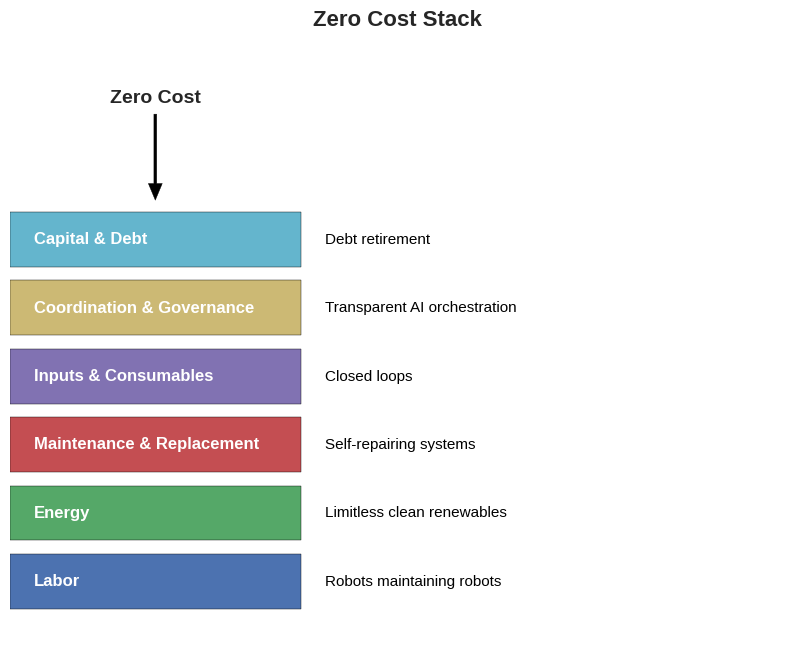
Zero Cost Stack
Every layer of cost — labor, energy, maintenance, inputs, coordination, and capital — is dissolved by synthetic systems powered by limitless clean energy. Robots maintain robots, renewables collapse energy costs, closed loops recycle inputs, and transparent governance eliminates overhead. When all layers converge, marginal costs for essentials structurally stabilize at zero, provisioning abundance as the ambient baseline.
Why the Stack and Dashboard Matter
🔧 The Mechanism
- Labor: Robots maintaining robots collapse recurring human labor costs.
- Energy: Once renewable infrastructure is installed, marginal generation cost trends toward zero; constraints are CapEx and storage, not fuel.
- Maintenance: Modular, self‑repairing systems reduce replacement cycles, with predictive AI already cutting downtime in industry.
- Inputs: Closed loops — seed regeneration, nutrient recycling, synthetic fabrication — dissolve recurring input costs.
- Coordination: AI orchestration eliminates waste and idle time, one of the largest hidden costs today.
- Capital: Transitional debt retired as abundance systems prove sustainable, collapsing financing overhead.
📊 The Verification
Automation density, renewable share, and coordination efficiency are the three measurable levers. As they approach 100%, each layer of the stack structurally collapses. This makes zero cost not just a vision but a verifiable outcome, trackable in pilot zones.
✨ The Outcome
- Near‑term: Dramatic reductions (60–90% in food, 40–70% in housing).
- Mid‑term: Maintenance and energy burdens dissolve as recursive robotics and renewables scale.
- Long‑term: With closed loops and recursive maintenance, marginal costs for essentials stabilize at zero.
⚖️ The Caveat
“Zero” here means structural marginal cost — the cost of producing one more unit of food, housing, energy, healthcare, or education. There will always be capital and resilience buffers, but those are transitional. Once the stack is fully collapsed, the provisioning baseline is ambient and effectively cost‑free.
Zero Cost Progress Dashboard
Progress toward zero cost can be tracked with measurable indicators. Each pilot zone reports automation density, renewable share, and coordination efficiency.
- Automation Density: 65% of tasks executed synthetically
- Renewable Share: 70% of energy from low‑marginal sources
- Coordination Efficiency: 55% reduction in waste/idle time

What the math guarantees
- Marginal cost collapse: As automation + AI + renewables scale, MC → 0.
- Provisioning capacity: Per‑capita provisioning rises toward guaranteed baseline as MC → 0.
- Debt retirement: Transition instruments reduce capital costs and fund build‑out; track retired debt, cost of capital, transparency index.